DSN WIRESUN 11 OCT 20260344 UTC
World
ANALYSISA devastating wildfire swept through the Croatian coastal town of Omiš overnight on August 13–14, 2026.
FILED 5 MIN READ
Omiš, Dalmatia, Croatia — August 14, 2026
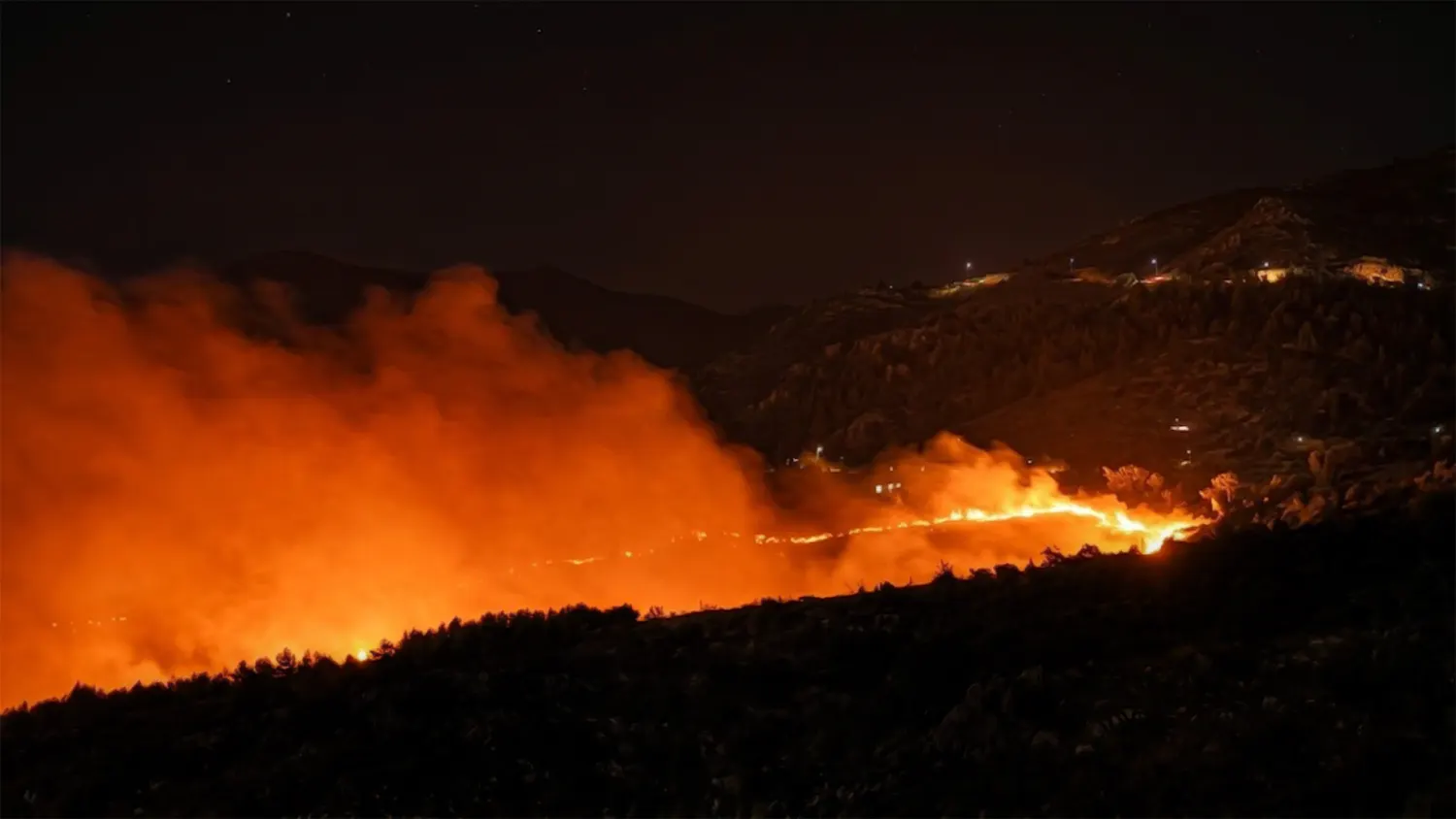
The footage looks like something from a feature film. The night sky over the Croatian coast turned deep red and orange. Flames raced down hillsides toward a town full of residents and summer tourists with nowhere to run. Houses ignited. Cars exploded. Boats on dry land burned. And Croatia's fire chief, watching from the command post, said something that stopped everyone around him: "I have never experienced anything like this in my career."
One woman is dead. One person is missing. Seven are in intensive care with life-threatening injuries. Two thousand people were evacuated in the night. And Omiš — one of Croatia's most beautiful and most visited Dalmatian towns — is assessing the ruins of its worst wildfire disaster in modern history.
A wildfire in Croatia driven by strong winds descended on the tourist town of Omiš overnight, engulfing houses, forcing about 2,000 people to evacuate and injuring dozens. Flames enveloped settlements and trees over 1,000 hectares, turning the night sky red above Omiš, a scenic town on Croatia's prized Dalmatian coast surrounded by trees and rocky hills.
Within a few hours, the fire spread to the edge of the town overnight. According to the fire brigade, around 1,000 hectares fell victim to the flames, with numerous houses, vehicles and boats also burning.
The fire began in the hills surrounding Omiš, fanned by the Bura — Croatia's notorious northeasterly wind, capable of gusting to extraordinary speeds in the narrow coastal valleys of Dalmatia. Once ignited in dry summer vegetation, the combination of terrain and wind created a fire front that moved faster than emergency services could respond.
Croatian police discovered the body of a woman in burnt-out scrub on Friday, after the wildfire swept through the coastal area. Police in Split located the body. Media reported that the body had been found in the village of Lokva Rogoznica about 30 kilometres south of Split. A 34-year-old Bosnian had been declared missing.
Of 36 people treated by ambulance services in the city of Split, about 25 km to the north, 14 were hospitalized and seven had life-threatening injuries.
Hospital officials said 40 people had been admitted to Split hospital, including a German and a Polish tourist. Ten victims were in intensive care, suffering from injuries including severe burns.
The seven — later ten — people in intensive care with life-threatening injuries include tourists from multiple European countries who came to Croatia's Dalmatian coast for a summer holiday and found themselves instead running from walls of flame in the middle of the night.
A major wildfire near Omiš, around 25 kilometres south-east of Split, forced about 1,200 residents and tourists to evacuate overnight on Thursday and into Friday as strong winds drove the flames towards the coastal town. Residents described chaotic scenes as they fled the advancing flames.
Strong winds fed the blaze between towns of Lokva Rogoznica and Omiš, prompting the evacuation of about 1,000 people overnight. Many of those were foreign nationals, including about 300 Czech tourists, according to information of the Czech Foreign Ministry.
Croatian Prime Minister Andrej Plenkovic pointed out that this was a "very densely populated" region, with a township of 15,000, currently bolstered by 12,000 tourists.
Emergency shelters opened in several towns on the stretch from Omiš to Split, accommodating those who had fled with nothing — no passports, no phones, no money, just the clothes they were wearing when the alarm sounded and the hills began to glow.
Polish tourists said they fled leaving their belongings behind in their apartments as the blaze approached.
Sections of the main coastal road near Omiš were closed, affecting links between Split and Dubrovnik as well as day trips and coach tours.
The fire swept through forested areas to destroy property and vehicles. The fire ripped through surrounding hills. Dozens of cars had been destroyed amid reports of homes being burnt. Many houses, cafes, restaurants, cars and boats that were on dry land were damaged.
The images emerging from Omiš on Friday morning show a landscape that looks nothing like the summer paradise that 12,000 tourists had arrived to enjoy. Burnt-out car husks sit on roads. House facades are blackened. Boats that had been hauled onto dry land for storage are charred frames. The rocky hills that give Omiš its dramatic beauty are stripped and scarred.
Chief national fire officer Slavko Tucakovic told media that he had "never experienced anything like this in my career. Unfortunately, many houses were damaged or burned down. It was frightening even to watch."
Nearly 300 firefighters were deployed overnight but were often outpaced by the blaze. The country's fire chief described the fire as "one of the worst in Croatia's history."
When a country's most senior fire official — a man who has spent his career fighting fires across Croatia's wildfire-prone coast — says he has never seen anything like it, that is the most precise measure available of how extraordinary the Omiš fire was.
Crews were also deployed to another wildfire on the Pelješac peninsula simultaneously as the Omiš blaze was burning.
Wildfires near popular tourist towns on the southern Croatian coast have left several people in critical condition with one person still missing.
The Omiš fire is not happening in isolation. Europe's summer of 2026 has been a summer of catastrophic wildfires from Scotland to Almería, from Los Gallardos in Spain — where 12 people burned to death — to the hills of Croatia's Dalmatian coast. The same combination of record heat, prolonged drought and powerful winds that turned Southern Spain's resorts into disaster zones in July has now reached the Adriatic.
Croatia received three times less rainfall than average in July 2026. The vegetation on the hillsides around Omiš was tinder-dry. All it needed was a spark and a wind. It got both.
The footage from the Omiš wildfire — shot by residents, tourists and emergency services cameras — has been described by those who watched it as looking like it came from a science fiction film. The night sky above the Dalmatian coast turned the color of fire. Columns of flame rose above hilltops visible for kilometers along the coast. The sea itself reflected the orange glow.
Croatia's fire chief was right. It was frightening even to watch.
DeSanta News will continue to follow the Omiš wildfire and Croatia's broader wildfire emergency throughout Friday August 14.
Subscribe to get the latest articles delivered to your inbox.
No comments yet. Be the first to share your thoughts.
World
World

World