DSN WIRESUN 11 OCT 20260349 UTC
World
ANALYSISRecord-breaking torrential rain struck southeastern South Korea on August 17, 2026, with 851.1 millimeters falling on Geoje over three days.
FILED 5 MIN READ
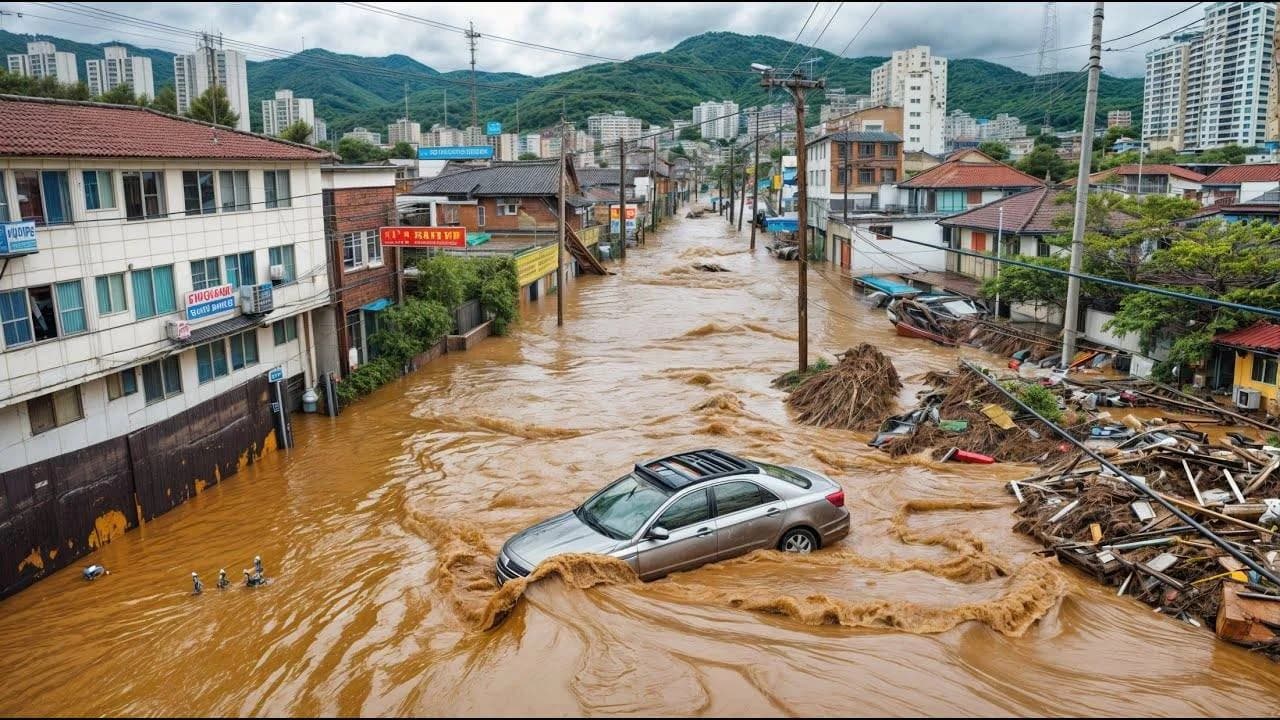
Geoje, South Gyeongsang Province, South Korea — August 17, 2026
South Korea's southeastern coast has experienced rainfall so extreme that meteorologists say events of this intensity occur once every two centuries. 851 millimeters of rain fell on Geoje in three days. 124.5 millimeters fell in a single hour — a historic record. At 4:32 in the morning, a landslide buried the first floor of an apartment building while families slept. One person is dead. And across the country, 838 reports of flood damage have been received in a single morning.
Record-breaking torrential rains poured down Monday on the southern coast, with Geoje recording 124.5 millimeters per hour — while Tongyeong saw 97.4 millimeters per hour. The Korea Meteorological Administration estimated that rainfall of such intensity would typically occur once every 200 years in Geoje and once every 100 years in Tongyeong.
According to the Korea Meteorological Administration, Geoje received 851.1 millimetres of rain from midnight Saturday through 1pm Monday, while nearby Tongyeong recorded 704.8mm. Sacheon received 380.5mm, while 441mm fell on Gadeokdo in Busan. The three-day cumulative rainfall amounted to roughly 90 per cent of the region's average precipitation for the entire June-August period.
To put these numbers in perspective: the United Kingdom's average annual rainfall is approximately 885 millimeters. Geoje received 851 millimeters in 72 hours — nearly a full year's worth of British rainfall in three days.
The deadly consequence of this extraordinary rainfall came at 4:32 in the morning, when most residents of Geoje's Okpo-dong neighborhood were asleep.
A landslide buried the first floor of an apartment building in Okpo-dong in Geoje. One person was taken to a hospital in cardiac arrest and later died, and two others suffered minor injuries. At around 5:05 a.m., another landslide struck Sanyang-eup in Tongyeong and buried one person, who was later rescued.
A landslide struck an apartment complex in Okpo-dong, Geoje, at around 4:42 a.m., covering a first-floor unit and leaving at least one resident dead. According to authorities, more than 20 emergency calls were received in Geoje between Sunday night and early Monday from residents seeking rescue from flooded or isolated homes and vehicles.
Rescue workers pulled three residents from the buried building. One was pronounced dead at hospital. The others received treatment for injuries. In Tongyeong, a second landslide buried a resident who was later pulled to safety by rescue crews.
As record-breaking torrential rains poured down Monday on the southern coast, landslides and flooding damage occurred one after another, centered around Geoje, resulting in one person dead and four injured, with 159 residents forced to evacuate.
An emergency disaster alert was sent to all Geoje residents at around 2:10 a.m. Monday, warning of the risk of landslides and river flooding and urging them to evacuate to safe areas.
The emergency alert came hours before the worst of the flooding — but even those who received it found evacuation difficult. Rivers had overflowed across multiple parts of the city, making it difficult for rescue crews to reach affected areas.
Residents endured a night of repeated emergency alerts as floodwaters rose across low-lying areas, with images and videos of submerged roads and neighbourhoods circulating on social media. "Overnight, I heard the loud emergency alert three times on my phone. Every time I was about to fall asleep, another alert came, warning of heavy rain and advising evacuation," said a Geoje resident surnamed Jeong, in his 50s. "It was still raining heavily this morning, and I heard that low-lying areas were flooded and in chaos."
A total of 838 reports of damage caused by the heavy rain had been received nationwide as of 10 a.m. Monday, with a preliminary toll of one dead and four injured, according to the Central Disaster and Safety Countermeasures Headquarters.
The 838 damage reports — received in a single morning — span flooding of roads, homes and businesses, landslides, fallen trees and infrastructure damage across South Gyeongsang Province and beyond. Rivers overflowed and roads were submerged in several parts of Geoje, making it difficult for rescue crews to reach affected areas.
The flooding also reached Tongyeong and other parts of South Gyeongsang Province, with authorities carrying out evacuations and rescues across a wide geographic area.
After weeks of drought, torrential rain triggered flooding and landslides across southeastern South Korea.
The combination of drought-baked ground and sudden extreme rainfall is one of the most dangerous scenarios in flood meteorology. When soil is parched after a prolonged dry period, it cannot absorb sudden heavy rain quickly. Instead, water runs off the surface immediately — overwhelming drainage systems, filling rivers and streams with extraordinary speed, and saturating hillsides until landslides become inevitable.
Geoje's geography — a coastal city surrounded by steep hills — made it particularly vulnerable. The same topography that makes the city scenic in good weather becomes a funnel for floodwaters and a generator of landslides when 800-plus millimeters of rain falls in three days.
South Korea experiences an annual monsoon season known as Jangma — typically running from late June to late July — during which a large portion of the country's annual rainfall is delivered in concentrated bursts. August rainfall of this scale is unusual even by Korean monsoon standards.
The 2026 monsoon season has been particularly intense across the Korean Peninsula, with South Korea recording above-average rainfall in multiple provinces throughout July and early August. The Geoje event — with its once-in-200-years hourly rainfall rate — represents an extreme outlier even within an already active season.
Heavy rain warnings remained in place across multiple regions of South Gyeongsang Province as of midday Monday, with more rainfall forecast throughout the afternoon. The Korea Meteorological Administration issued warnings for Geoje, Tongyeong, Sacheon, Goseong, Namhae and Changwon.
Rescue crews remain active across the affected areas. The search for additional victims continues. And the 838 damage reports received by midday represent a preliminary figure that is expected to rise as crews reach areas that floodwaters have so far made inaccessible.
DeSanta News will continue to follow the South Korea flooding emergency throughout Monday August 17.
Subscribe to get the latest articles delivered to your inbox.
No comments yet. Be the first to share your thoughts.
World
World
World