DSN WIREFRI 18 SEP 20262015 UTC
World
ANALYSISSpain has deployed its military to Ceuta after approximately 60,000 people — more than half the enclave's population — crossed from Morocco in just a few days.
FILED 5 MIN READ
Ceuta, Spain / Madrid — July 31, 2026
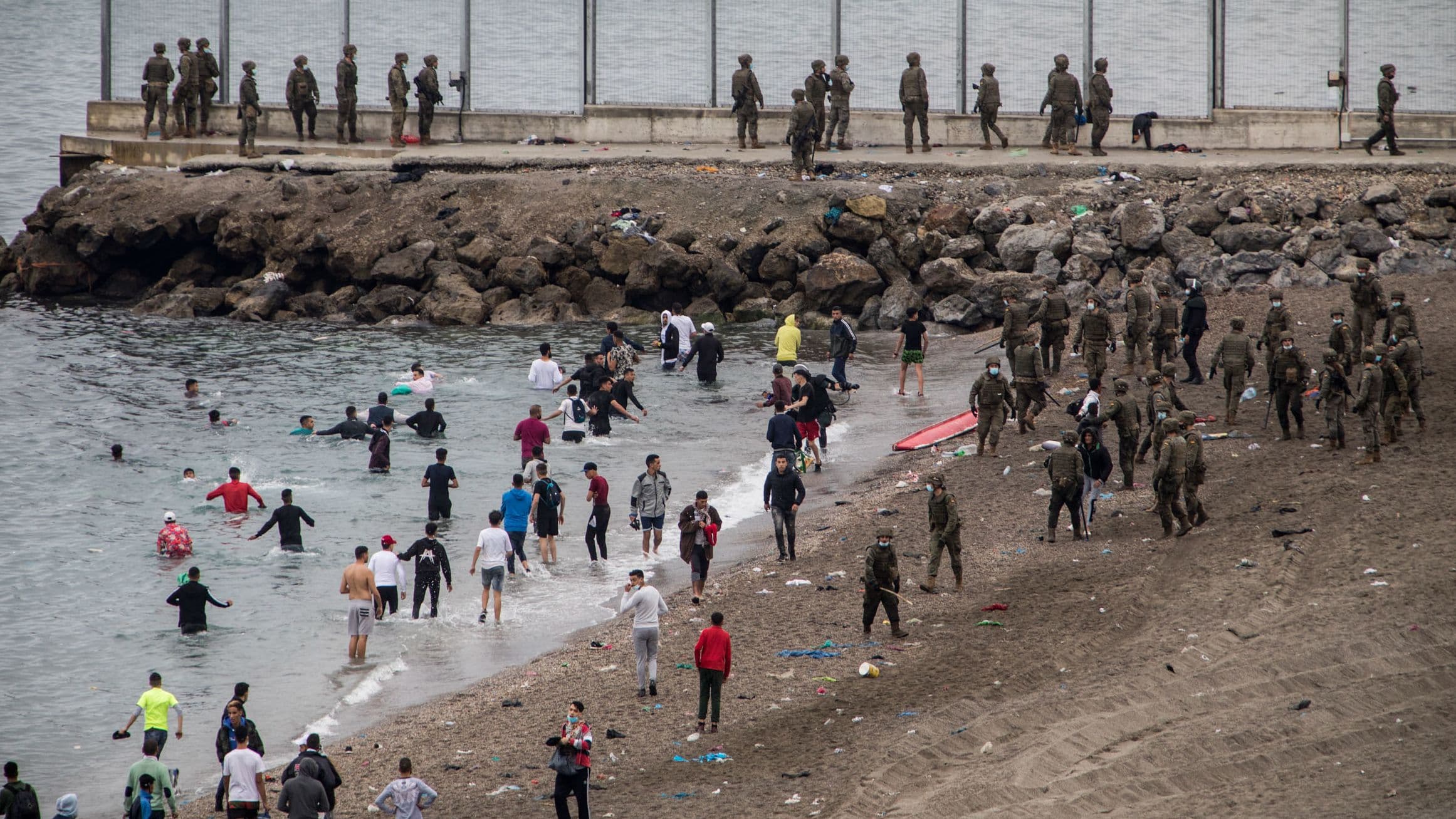
Spain is facing its worst migration crisis in modern history. The tiny Spanish enclave of Ceuta — a 19-square-kilometer sliver of European soil on the northern tip of Africa, home to 84,000 people — has been overwhelmed by the largest single migration surge in its history, with approximately 60,000 people crossing from Morocco in just a matter of days, at least 34 dead, the Spanish military deployed and an entire continent watching in shock.
Spanish Prime Minister Pedro Sanchez visited Ceuta on Friday where he met security officials and regional authorities. He said about 60,000 people had entered Ceuta over the past few days — which is more than half the enclave's population.
To understand the scale of what has happened, consider the mathematics. Ceuta is a city of 84,000 people. In just a few days, the equivalent of more than half its entire population has crossed the border from Morocco. The enclave's infrastructure — its hospitals, its water supply, its food distribution, its police and its housing — was built for 84,000 people. It is now trying to cope with the sudden addition of 60,000 more.
"The situation is absolute chaos," said Rachid Sbihi, head of the association that represents Spain's Civil Guard officers in Ceuta, who police the border. "It's not possible to give precise numbers, but there are thousands of migrants crossing," he said, adding that the border had "totally collapsed."
Among the 34 people reported killed, many drowned while attempting the sea crossing while others died in a crush at the breakwater fence near Tarajal beach, according to authorities.
Bodies could be seen floating in the water. Spain's government delegation in Ceuta said at least nine people died on Thursday during the chaos alone. It did not provide details on the circumstances of the deaths.
The images of bodies floating in the waters between Morocco and Spain are among the most devastating produced by any migration crisis in Europe in recent years. People who crossed an ocean of hope and drowned within sight of European soil.
Thousands of people crossed into Ceuta on Thursday and continued arriving overnight into Friday, travelling by sea and over land.
Footage from the Reuters news agency showed large groups of people, mostly young Moroccan men but also families with women and children, moving around the breakwaters and onto roads inside Ceuta. The remains of a burned bus and seven cars were visible near the border after clashes between security forces and crowds.
Although the main border crossing appeared blocked, groups of migrants continued moving along the coastline, searching for alternative routes, and some prepared to swim around breakwater barriers.
Furious Spanish citizens were forced to chase migrants down the streets of Ceuta. Upon their arrival, migrants largely from Morocco and Algeria went into the city. In response, enraged Spanish citizens took to the streets. Many were seen waving Spanish flags and screaming at them.
Spain's government said it would send the Armed Forces to help the Civil Guard "to maintain security in the city of Ceuta." Spanish authorities reinforced the enclave with military personnel and additional police while Morocco deployed security forces and water cannon to push back crowds approaching the border.
The deployment of Spanish Armed Forces to Ceuta represents one of the most significant domestic military operations Spain has conducted in years — a visible admission that the country's civil authorities have been overwhelmed by the scale of the crisis and that restoring order requires military force.
Prime Minister Pedro Sanchez flew to Ceuta on Friday alongside Interior Minister Fernando Grande-Marlaska to personally assess the situation and meet with security officials and regional authorities. The prime ministerial visit reflects the political gravity of the crisis — a Spanish government that has been accused of allowing immigration to spiral out of control is now watching that criticism play out in the most dramatic possible fashion.
Spanish intelligence believes that the invasion of Moroccan immigrants into the Spanish enclave of Ceuta is a false flag operation orchestrated by the Moroccan government on the orders of King Mohammed VI.
Achraf Maimouni, a member of the Moroccan Association for Human Rights in northern Morocco, described the situation as "exceptional." "The Tarajal border was opened under unusual circumstances this morning and people crossed," he said.
Spain's interior ministry said the Moroccan government was "closely cooperating" with Spain to handle the situation and that Moroccan police were stopping numerous migrants attempting to reach Ceuta from Morocco.
The contradiction between Spain's official line — that Morocco is cooperating — and Spanish intelligence's assessment that Morocco orchestrated the surge is one of the most explosive political subplots of the crisis. Morocco has used Ceuta migration as a diplomatic pressure tool before — most notably in 2021, when the border was similarly opened under unclear circumstances following a diplomatic dispute over the treatment of Western Sahara separatist leader Brahim Ghali.
The surge has triggered political tensions across Europe with France announcing tighter checks at its border and Spain and Italy threatening new measures to curb migration, including calls by senior politicians to suspend Spain from the Schengen free-travel area.
The Ceuta crisis has sent shockwaves across Europe — reigniting the continent's most divisive political debate at a moment when European governments from Paris to Rome to Warsaw are already under intense domestic pressure over migration.
France's announcement of tighter border checks reflects the fear that 60,000 people who have entered Ceuta may not stay there — and that many will attempt to continue northward toward France, Germany and Scandinavia via Spain and the Schengen area.
The calls to suspend Spain from Schengen — an extreme measure that would effectively restore border controls across the entire Schengen zone — reflect the depth of anxiety among European governments about what is happening in Ceuta.
The scene was reminiscent of 2021, when about 10,000 migrants entered Ceuta territory. Spain deployed troops to reinforce police after thousands of migrants crossed from Morocco in May 2021.
In 2021, Spain considered 10,000 arrivals a crisis that required military deployment. In July 2026, 60,000 have arrived — six times more — in a matter of days.
Ceuta and Melilla — Spain's two tiny territories on the African continent — have been the primary land entry points into the European Union from Africa for decades. They represent, for millions of people across sub-Saharan Africa and North Africa, the most achievable gateway to a European future. The 2026 surge is the latest — and by far the largest — expression of a pressure that has been building for years and which no European policy has yet found a way to sustainably manage.
DeSanta News will continue to follow the Ceuta crisis as the situation develops throughout Friday July 31.
Subscribe to get the latest articles delivered to your inbox.
No comments yet. Be the first to share your thoughts.
World
World
World