DSN WIRESUN 11 OCT 20260422 UTC
Military / War
ANALYSISRussia launched one of its most devastating aerial attacks of the entire war on Kyiv on July 2, 2026 — firing 74 missiles and 496 drones at the Ukrainian capital and other cities.
FILED 5 MIN READ
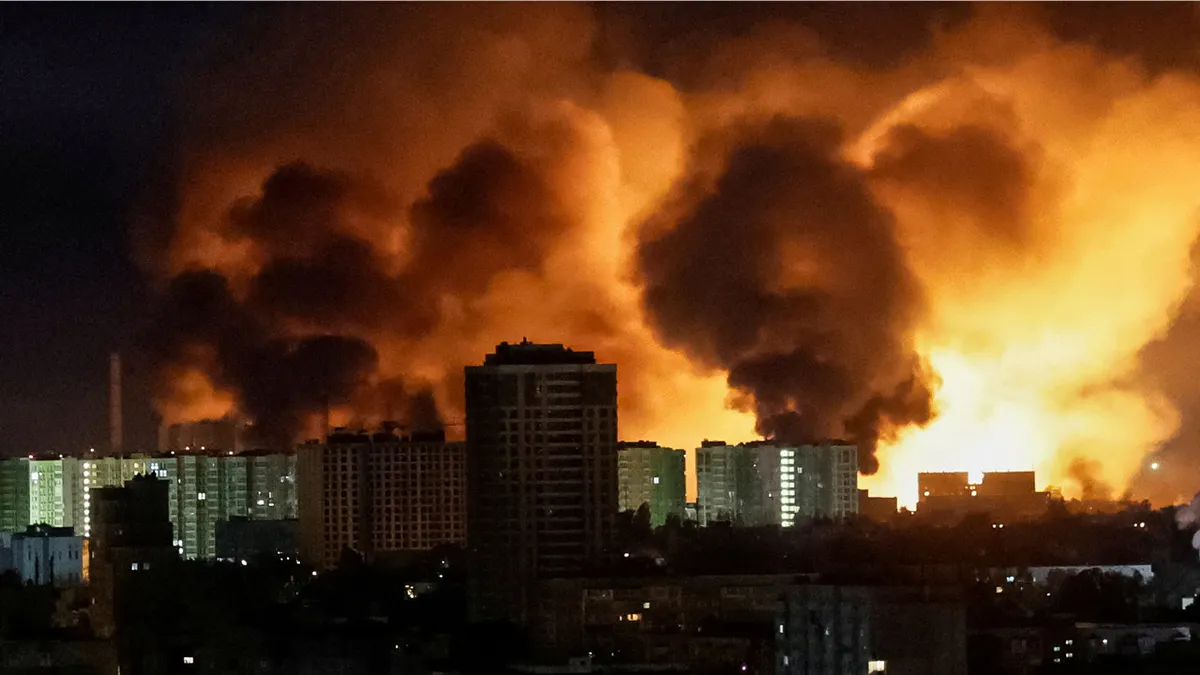
Kyiv, Ukraine — July 2, 2026
Russia unleashed one of the most devastating aerial barrages of the entire war on Ukraine's capital and other cities overnight on July 2 — killing at least 18 civilians, wounding more than 81 others and destroying a nine-storey residential building as the Kremlin launched what it called "retaliation" for Ukraine's escalating drone campaign against Russian oil infrastructure and cities.
Ukraine's air force said Russia launched 74 missiles and 496 drones overnight — a combined total of 570 aerial weapons directed at Ukraine in a single night. The attack caused the widest destruction in Kyiv so far in 2026 and was the deadliest strike on the capital since at least May, when 24 people were killed in an attack that brought down an apartment block.
The explosions shook central Kyiv for hours as thousands of residents rushed into bomb shelters and underground metro stations. Yuri Ihnat, the Ukrainian Air Force spokesperson, said the number of ballistic missiles was unusually high and that the interception rate for them was low, as Ukraine continues to face shortages of Patriot missiles — stocks that have been depleted in part because of the US military's involvement in the Iran war.
Russia's Defense Ministry said in a Telegram post that its "massive attack" used long-range, high-precision weapons and drones to strike military and energy facilities, as well as airports in Kyiv and other locations. Moscow said the attack was retaliation for Ukrainian drone strikes on Russia.
At least 18 people were killed and more than 81 wounded in Kyiv alone, said Tymur Tkachenko, head of the Kyiv City Military Administration. Emergency crews searched through the rubble of a nine-story building on the left bank of the Dnipro River as fires continued to burn after sunrise.
The human stories emerging from the rubble are devastating.
Olena Dniprovska, 65, and her husband Yevhen, 64, were wounded in their apartment in Kyiv's Podilskyi district. "I went out into the corridor with the phone, and before I understood what happened, everything fell on my head, the glass, and the door blew off," said Dniprovska, dried blood streaked across her face and a bandage on her chin. "I ran out into the front door and started calling my husband from the room, but he was also blown out by the blast wave." "Now I have nowhere to live, the apartment is completely destroyed, no doors, no windows, no balcony. You can step straight from the room out onto the street," she said.
Kyiv Mayor Vitali Klitschko declared Friday a day of mourning and said damage had been recorded across the city of roughly 3 million people. Ukrainian President Volodymyr Zelenskyy had warned of an imminent "massive" Russian strike on Wednesday evening, urging citizens to take shelter and pay attention to air raid alerts across the country.
Ukrainian President Volodymyr Zelenskyy, who had been on a visit to Ireland, cut short his trip and returned to Ukraine immediately following the scale of the attack. Zelenskyy had warned of an imminent massive strike and moved rapidly to return to his country as the extent of the overnight destruction became clear.
Zelenskyy appealed for more US and European support, describing the massive overnight attack as "an explicit statement by Russia: If Ukraine is not protected from ballistic missiles and other missile strikes, those strikes will continue."
Damage had been reported at more than 20 sites across the capital, Zelenskyy said.
Katarina Mathernova, the European Union's ambassador to Ukraine, said Russia "unleashed hell on Kyiv" overnight and struck accommodation used by diplomatic personnel. Diplomats were not injured, but their belongings were damaged in a fire that engulfed the building, she said.
The strike on a building housing diplomatic staff represents a significant escalation — targeting facilities that carry diplomatic protection under international law.
Poland's Armed Forces Operational Command scrambled fighter jets and said the measures were of a preventive nature and aimed at securing and protecting the airspace, "especially in areas adjacent to the threatened regions." Finland also implemented airspace restrictions as neighboring countries monitored the scale of the attack.
Russia's latest attack comes as Kyiv has stepped up long-range drone strikes inside Russia, targeting oil refineries, military facilities and major cities, including Moscow and St. Petersburg. Ukraine said it hit an oil refinery overnight in Russia's Nizhny Novgorod region, where the regional governor reported one person killed in a strike on an industrial facility.
Ukraine's deep-strike successes had prompted some analysts to suggest the conflict could be turning in Kyiv's favor, with Putin acknowledging the impact of Ukrainian drone strikes on Russian fuel production for the first time. "As envisaged by the Defense Strategy of Ukraine, we are depriving the enemy of resources for waging war," the Ukrainian defense ministry said on Telegram.
Ukraine's shortage of air defense systems — in part because of depleted US stocks from the Iran war — has left civilians especially vulnerable to ballistic missiles, even as Kyiv's defenses stop most of Moscow's drones.
Zelenskyy's appeal for more Patriot missiles is not new. But the scale of the July 2 attack — and the unusually high number of ballistic missiles that got through — gives his request a new and urgent weight. Without interceptors, Russia's ballistic missiles reach their targets. And their targets are apartment buildings where people sleep.
Ukraine's UN Ambassador Sergiy Kyslytsya called Russia a "pariah state" following the overnight attack. "And yet, this barbaric Russia continues to be treated at the UN as a normal member state," he said. "It is time to end this parallel reality. Russia's status as a permanent member of the Security Council should finally be called into question. Russia should be treated for what it has become: a pariah state."
The statement reflects a growing international frustration with Russia's continued membership of the UN Security Council — a body whose founding purpose was to maintain international peace and security, and whose permanent member is currently launching 570 missiles and drones at civilian apartment blocks in a single night.
The July 2 attack is Russia's answer to Ukraine's escalating drone campaign. Ukraine strikes Russian oil refineries. Russia strikes Ukrainian apartment buildings. The cycle of escalation continues — and it is Ukraine's civilians who pay the price.
Zelenskyy is back in Kyiv. The mourning has begun. The search for survivors continues in the rubble of a nine-storey building on the left bank of the Dnipro. And somewhere in Moscow, Putin's military planners are already preparing the next attack.
DeSanta News will continue to follow developments from Kyiv and across Ukraine.
Subscribe to get the latest articles delivered to your inbox.
No comments yet. Be the first to share your thoughts.
Military / War
Military / War

Military / War